Conference Survival Tips (by Hubs)

Room

With more than 20 years of conference going experience under my belt, I feel as though I’ve become a bit of an expert on this particular subject.  At various times over my career I’ve been an attendee, a speaker and even a chairman a time or two.  With the three day Wine Bloggers Conference just around the corner I thought I would share some of what I’ve learned over the years to help you successfully navigate your way around any conference and also avoid the many pitfalls that exist to the unwary.

Let me say at the outset that these survival tips apply only tangentially to the upcoming Wine Bloggers Conference.  My conference going experience to date has been almost exclusively dedicated to the tax arena which, as you may surmise, is about as far on the other side of the fun spectrum from wine blogging as exists in the time/space continuum.  That’s right friends, there are entire weeklong conferences dedicated to the subject of taxes, and you can bet that they are just as hot and sultry as you imagine them to be!    As close as I’ve ever been to the fun end of the conference spectrum was speaking at a craft brewers convention a few years ago at which they asked me to present with a pilsner at the lectern.  My presentation was at 9am.

So with that in mind, here are a few lessons that I’ve learned over the past two decades of conference going to help you out…

Find the (better) restroom.  Rookie conference goers will use the restrooms Restroomimmediately outside of the main conference hall.  Don’t be fooled – no need to stand in line for ten minutes for the privilege of sharing the facilities with 200 of your closest friends.   These conference halls (either in a hotel or a dedicated facility) are labyrinths that are designed to host multiple conferences at the same time.  So just walk the hallway toward one of the other large conference rooms that isn’t currently in use and there you will find your very own restroom (just don’t tell anyone where it’s located). (Editor’s Note: spouses are exceptions to this “don’t tell anyone” rule).

Monitor your coffee and sugar intake.  This probably should have been listed as survival tip #1.  Either at the back of the main hall or in the exhibitors hall there will undoubtedly be a tanker sized vat of black coffee next to several trays of Costco chocolate chip cookies.  I know exactly what you’re thinking: “Awesome!”  No.  No it is very much not awesome.  Cookies and coffee are the opioids of the conference world and if you’re not careful you’ll be so hopped up on caffeine and sugar you’ll need a methadone clinic visit of your own to help you come down.  Allow yourself one of each in the morning and the same after lunch.  That’s it.  (Editor’s Note: as this is a wine blogging conference, avoid drinking coffee too close to any actual wine tasting to avoid completely screwing up your palate.  Same goes for brushing your teeth.)

Stretch.   Sitting all day is terrible for you so get up and walk around.  It’s ok to stand at the back of the room during an entire presentation.   You’re not being rude as long as you’re not the guy who shows off his yoga skills by doing a headstand in the main conference room.  FYI:  I actually witnessed a guy waiting at the departure gate at SeaTac Airport go into a full headstand right smack in the middle of everyone waiting for the plane.  I still hate that guy and that was like five years ago. (Editor’s Note: perhaps doing some yoga of your own my dear Hubs would help you with this anger that you’ve been holding onto for so many years.)

Hydrate.  Drink a ton of water – I’m not kidding.  Those conference rooms are where fresh air goes to die and you’ll otherwise dry out by the mid-morning break.  I’m talking Las-Vegas-casino-before-smoking-was-banned level of stale air, just without the lingering waft of desperation mixed with Drakkar Noir.  There’s typically a bunch of water bottles at the back of the room or in the exhibitors hall so load up accordingly.  (Editor’s Note: I completely agree with Hubs here – a rare occurrence.)

SpitbucketBe a good conference neighbor.  This should be self explanatory, but as with most things in life that fall into that category, it unfortunately is not.   Generally clean up your area, if you get a phone call take it outside (we get it, you’re a very busy and important person who owns a cell phone and we are all duly impressed with your station in life), don’t eat a bag and a half of Doritos so loud that we can’t hear the speaker, etc.  You know what, this goes beyond conference etiquette – just generally follow these simple rules in life. (Editor’s Note: another wine blogging conference specific: mind the spit buckets! Don’t go jostling the table too much or slamming your chair into the table behind you and putting your fellow conference goers at risk for dump bucket spillage.  Nobody wants to be Miles.)

Leave the cocktail reception early.  At the end of Day 1 there is always a cocktail reception for the attendees.  Go early and – here comes the really important part –  leave early.  Tomorrow is another full day of presentations and the last thing you need is to be sweating booze while wondering why the hell you decided to karaoke the entire soundtrack of Grease 2.  Also, if invited, politely decline attending the after party at a local bar with your newfound “conference buddies.”  Nothing good ever comes from attending a conference after party.  (Editor’s Note: Ahem… is there something you’d like to share with me?)

OK – that should be enough to get you through.   Godspeed my conference going friends.

Introducing Outwines’ First (and Possibly Last) Ever Guest Blogger . . .

WBC

Hello wine world, Hubs here.   In less than a week I will be attending the Wine Bloggers Conference in Walla Walla, Washington together with Mrs. Outwines.  I mean, I’ll actually be attending the conference itself, like sitting in on lectures and stuff, not just hanging out in the bar at the Marcus Whitman watching college football while waiting for Noelle.  My attendance may seem a little strange due in part to the fact that I don’t know anything about wine and I don’t…well…you know….blog.  Despite these minor impediments, I am looking forward to a terrific weekend in EWA (shorthand for “Eastern Washington” – I married a local girl who also taught me about the nearby nuclear reactor and state penitentiary).  But believe me when I tell you that the wine from this part of the world is absolutely amazing.

When I first asked Noelle if I could “guest blog” on Outwines for the week of the conference she summarily rejected my offer.  I mean, she didn’t even give it a second of thought before “hell no” tumbled out.  What followed was a protracted negotiation between husband and wife that hammered out the most minute details that would ultimately allow me to rent space on Outwines so that I could actually participate as a wine blogger.  The final mutually agreed upon rules of the road – negotiated with such vigor that the Yalta Conference paled in comparison –  are as follows:

Her 5 Rules of the Road:

Rule #1:  Noelle has full editorial control.   This isn’t much of a derivation over our last 20+ years of marriage so I’m not particularly concerned about relenting on this one.  Plus, what the hell else was I going to do?  I don’t have a blog of my own so I had to relent.  That, dear reader, is called leverage.

Rule #2:  I can’t embarrass her or Outwines.  This one may be a bit more difficult as embarrassing Noelle is kinda my calling card.  If I’m a one trick pony, that’s my trick – and if I don’t my saying so, I’m otherworldly great at it.  Nonetheless, I will endeavor not to dilute her personal brand or bring shame upon the House of Outwines in any manner over the course of the next week.  After that, all bets are off.

Rule #3:  I have to be content appropriate.   I actually have to commit to blogging about wine, the craft of blogging, the conference, and our time in Walla Walla.   What she really means is that I can’t use this space to unleash my repressed stand-up comedian chops or provide you with my take on the current state of the world (we are all totally fucked).

CursingRule #4:  I can’t swear too much.   Late entry inserted after she read Rule #3 above.  Kindly disregard – won’t happen again (it totally will).

Rule #5:  I have to commit to learning about wine and blogging.    It is a wine bloggers conference, so this seems like a reasonable request.

His 5 Rules of the Road:

Rule #1:  No Emojis.   Hemingway didn’t use ’em so neither will I.   The fact that emojis didn’t exist during Papa’s time is totally irrelevant.
sun-also-rises

Rule #2:   Social Media Delivery.   Noelle is required to post on Outwines’ Instagram & Twitter accounts a link to my blog entries (including #WBC18 tags!).  I could see her conveniently “forgetting” to promote my spectacularly insightful content so this is a win for me now that she’s contractually obligated.

Rule #3:  No Outlines.   My wife kicked my ass in law school which I attribute primarily to two things: (i) she’s much smarter than me; and (ii) her unfailing ability to learn subject matter via the outlining format.  She has migrated this ability to the world of wine and this blog as she continues to outline her way through the WSET world.   I have neither the time nor the cerebral ability to do the same.

Rule #4:  I get to write in my voice from my perspective.  I’m an outsider to the worlds of wine and blogging – thus my perspective will be through those dual lenses.   I can (and most certainly will) ask stupid questions – so be it.

Rule #5:  I get to have a beer once in a while – and can even blog about it.  I’ve seen the agenda, tasting schedules, and field trips to various Walla Walla wineries – that’s a lot of wine.   I need to break it up with a Kölsch once in a while, and we’re conveniently staying close to Public House 124, so that shouldn’t be a problem.

Well, that just about puts a bow on my very first blog entry.   The rules have been clearly established and I’m ready for the conference.  Now let’s see if Noelle will let me borrow her laptop…

… Editors Note: Not fucking happening 😉

Chenin Blanc: Overlooked and Underappreciated in the Wine World

There are several significant milestones in a wine blogger’s early life:  The first time you hit the “publish” button and put your thoughts – and yourself – out there to the world.  The day you get a follower who isn’t a personal friend, or someone you’re related to. And then there’s the day you receive your first wine samples to review.  One year into my blogging adventure I have officially hit this particular milestone – and let me just say, it was worth the wait.

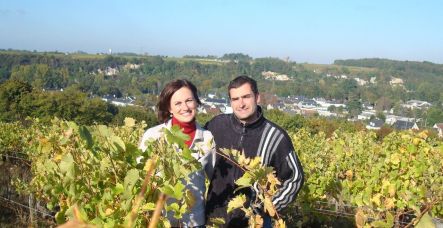
Tania and Vincent
Tania & Vincent Carême (photo credit: Cape Classics)

As one of their contributors, I’d been asked by The Vintner Project to write a piece on Vincent Carême and his wife, Tania – winemakers in both the Loire Valley and South Africa.  So, while I require a nap on most days, these two are busily making wine in two different hemispheres!  The primary focus of  their production in both regions is Chenin Blanc.  Now, I’m not overly familiar with Chenin Blanc – and while I don’t actively avoid it, I also don’t necessarily seek it out either.  Unfortunately, the majority of what I have had has been either underwhelming as a whole, or overwhelmingly full of that classic wet wool aroma that you can get in Loire Chenin Blancs.  (Which isn’t an altogether unpleasant aroma – but one that I’d usually prefer in my winter sweaters as opposed to my wine glass.)

So before I cracked open my samples, I did a little background research on Chenin Blanc with the hopes that I could understand (and appreciate) more of what I was tasting.

Chenin Blanc – The Grape.

Chenin Blanc originated in the Anjou region of France – which is located in the central portion of the Loire Valley.  The grape might have been cultivated as early as 845 A.D. – although the words “Chenin Blanc” don’t appear in print until 1534.  Today, France has just under 25,000 acres devoted to the grape.  And down in South Africa – it’s THE most planted variety at 46,000 acres. Chenin is also grown in Argentina, my beloved Washington state, as well as California.

Chenin Blanc is incredibly versatile and used to produce a wide range of wines from still, to sparkling (i.e. Crémant de Loire), to lusciously sweet wines (i.e. Quarts de Chaume) and even some fortified wines, particularly in South Africa.  As a still wine, Chenin is often quite high in acidity with aromas and flavors of citrus (tangerines, lemons), green or golden apples and honeysuckle . . . which is right in my wheelhouse of wines.  So, I have to ask myself: why aren’t I drinking more of this stuff??!  Chenin Blanc Unit 2

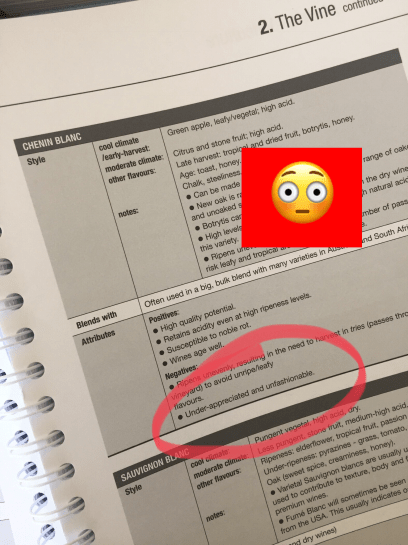
Unlike ubiquitous Chardonnay and Pinot Grigio, Chenin Blanc isn’t very prevalent on restaurant wines lists or on wine store shelves.  It also isn’t a trendy grape like Assyrtiko or Grüner Veltliner (although it IS a helluva lot easier to pronounce!)  I mean – my WSET Unit 2 textbook even specifies that one of Chenin Blanc’s negative attributes is that it’s unfashionable! The fact is – I don’t drink a lot of Chenin Blanc because I don’t THINK about it.  It’s out of sight out of mind.  But a good producer can change all that . . .

Chenin Blanc – The Wines.

Onto the samples . . . and as always, all opinions and thoughts are my own…

Terre Brûlée 2017 ‘Le Blanc’ Chenin Blanc, Swartland, South Africa. (13% abv)

  • Color: Pale lemon-gold
  • Aromas: Yellow apple, Meyer Lemon, faint honeysuckle, minerality (wet stone), there’s some herbal notes in here too
  • Palate: Medium- body, high acidity.  More tart on the palate than expected with additional flavors of green apple and unripe pear.
  • My Thoughts: Super-refreshing, crisp wine.  The acid is definitely at the forefront and while I like (and actually gravitate towards) acid bombs, it might be a wee bit much for some people.  If that’s the case – I’d recommend balancing it out by pairing with a light salad dressed with a snappy vinaigrette.
  • Technical Bits: The Terre Brûlée estate was established by Vincent and Tania in 2013.  Located about an hour north of Cape Town, the soils here are mostly shale and granite.  Grapes are hand harvested and whole bunch pressed.  Only natural, wild yeasts were used for fermentation.

Domain Vincent Carême 2017 ‘Spring’ Vouvray, Loire Valley, France. (13% abv)

  • Color: Pale lemon-gold
  • Aromas: Slightly riper yellow fruits on the nose with this one – apples and pears, white flowers, hints of cheese and white mushrooms
  • Palate: Medium body, medium+ acidity. Picked up flavors of honeysuckle and chamomile.  Riper palate and creamier texture than the ‘Le Blanc.’
  • My Thoughts: This wine was a little more complex to me than the first.  The acidity was less linear/searing, making the wine feel more in balance.
  • Technical Bits: Chenin grapes for ‘Spring’ are outsourced from growers who have worked with Vincent for years and who allow him to provide input and assistance throughout the year.  Soils from these vineyards range from clay to flint to limestone.  Like his South African Chenin, grapes are hand harvested and whole bunch pressed – and native yeast fermentation is used here as well.

Domaine Vincent Carême 2015 ‘Le Clos’ Vouvray, Loire Valley, France. (13.5% abv)

  • Color: Medium- lemon-gold
  • Aromas: Yellow apple (yet again!), honeysuckle, soft cheese, white mushroom and a slightly nutty quality
  • Palate: Medium body, medium+ acidity.  Long-ass finish.  Creamy texture here as well.  Flavors all over the board here with some tangerine, orange blossom, apricot and the beginnings of something marmalade-like.
  • My Thoughts: This wine is freakin’ delicious.  I love a wine that I can keep going back to and find something different on the nose or a different flavor.  The first night I had this wine without food, the second I paired with a chicken/mozzarella pasta – it was awesome both times.
  • Technical Bits: ‘Le Clos’ is a single vineyard wine from 50-70 year old bush trellised vines.  ‘Le Clos’ translates to “enclosed vineyard” and this six acre property is indeed enclosed by an ancient stone wall.  Soil here is the famous tuffeau – a chalky, fine grained type of limestone found only in the Loire Valley.  As with the other Chenins, the grapes here were also hand harvested and whole bunch pressed.  Native yeast fermentation was carried out partially in clay amphora followed by 12 months lees aging.

Careme wines

Overall, I was incredibly impressed with these samples and will seek out more Chenin Blanc at my favorite local wine store.  If any of these wines sound interesting to you – please visit Cape Classics for information on distribution in your area.  (And that’s not a paid advertisement – I just really liked their wines!) 🙂

My article on Tania and Vincent for The Vintner Project is forthcoming and I will have a link HERE when it’s up and running! In the meantime, if you’d like more information – here’s my outline on Chenin Blanc.


WSET Diploma Unit 5: Opting for the Sparkly Object

After successfully completing Unit 2, I started thinking about the next Unit I was going to tackle in my WSET Diploma pursuit.  (Ok, let’s be honest, I started thinking about this months before actually completing Unit 2).   So without further ado, here were my options, my thought process, and my decision (Spoiler Alert:  Bubbles.  Always Bubbles).

Unit 1 – Global Business of Alcoholic Beverages.

There are two parts to Unit 1: a 3,000 word research paper and an in-class case study exam.  Candidates can do either of these at any time during the Diploma process.  Both involve a fair amount of research and writing, which as a former lawyer, I was actually pretty damn good at once upon a time.  So, I’m looking forward to tackling these writing assignments – assuming I’m assigned a topic that I enjoy writing about.

The research paper topics are established by WSET and are released each academic year.  This year’s were released in early August, and neither one particularly spoke to me: “The short and long term implications of the 2017 vintage“, or “The Rum Revival.”  The 2017 vintage question seems incredibly broad and I’m not all that excited about spending a lot of time researching spirits – particularly since spirits will no longer be a required Unit of the Diploma beginning in August, 2019.  I’m optimistic that when I get around to doing the paper that both options will be more wine related . . . and hopefully one will be “why Washington state is the future for the United States wine industry.”  A gal can dream, can’t she?

The case study exam is offered three times a year. This is a complete grab bag of alcohol business topics – past case studies have ranged from “social media and the wine industry” to “the négotiant system in Burgundy” to “the wines of South Africa.” I think any of these would’ve been fascinating to explore in detail, which of course means that when I register for the case study (likely in March 2019) my topic will be something like “what sulfur dioxide means to me” or “why mass produced New Zealand Sauvignon Blanc is the most awesomest wine in the world.”

Unit 3 – Light Wines of the World.

This is the behemoth of the Diploma – covering all wines of the world that don’t fit into the Fortified or Sparkling categories.  I don’t know if the tales of its difficulty are greatly exaggerated or not, but I’m not planning to find out any sooner than I need to.  Unit 3 will be my last Diploma Unit.

Unit 4 – Spirits of the World.

My wine school is doing one last offering of the Spirits Unit and exam. I originally had this all worked out before we moved down to SoCal – my father-in-law (the infamous T-Bone) was going to be my spirits study-buddy and Hubs and Mom-in-Law (aka Authorista) were going to foot the (bar) bill. T-bone and I would frequent local watering holes to sip and study and then head back to our respective homes for our daily nap.  Win-win for everyone. Well, two of us anyways.

However, since Spirits soon won’t be part of the Diploma program, I struggled with whether to try and tackle this Unit or not. I eventually opted for not.  Sorry, T-Bone. Sidenote: don’t actually feel sorry for him.  I’ve been stocking his wine “cabinet” (underneath his bathroom sink) with Oregon Pinot and Washington Syrah since we moved down here.  He’s fine.

Unit 5 – Sparkling Wines of the World.

See Below.

Unit 6 – Fortified Wines of the World.

Unit 6 is being offered in early September and the exam is on the same date as Unit 5.  I know several candidates that are tackling both Units together – and I considered this for about 5 seconds . . .

Bottom line is – I’m not in a huge rush to finish the Diploma.  And, like much of what I do in life, would prefer to methodically and systematically go through my studies as opposed to frantically cramming it all in.  I am a true ISTJ.  So, I opted for the Unit that interested me the most – the shiny object of the Diploma – Sparkling Wines of the World!

Champagne books
Unit 5 – In-Class Experience.

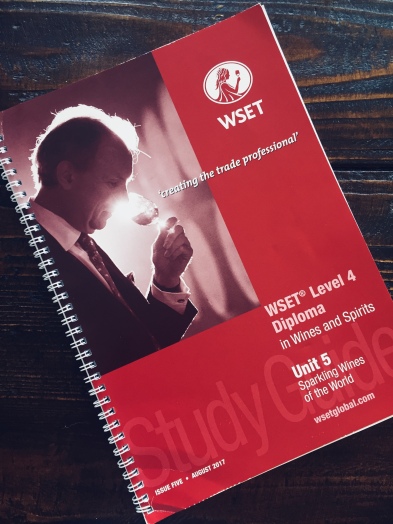
After registering for Unit 5 the day after my Unit 2 exam (seriously – I am Tracy Frickin’ Flick!) I did a little prep work by starting in on some of the suggested readings.  Class itself was one very intensive, very full day in early August.  Other WSET providers spread Unit 5 in-class time over two days (Napa Valley Wine Academy), or three weeks plus a practice exam (Capital Wine School).  WSET Unit 5 manual

My class was a broad overview of sparkling wines – from different production methods, to Champagne sub-regions, to common labeling terminology.  We also tasted through 11 different sparkling wines in class.  Although, unlike Unit 2, this wasn’t blind and there was quite a bit less class discussion on them as well.  Maybe this was because there were more students in class (10 compared to my 3 in my Unit 2).  Or because it was a sunny summer Saturday and people wanted to skedaddle. Although, this is SoCal, almost every Saturday is sunny.

Whatever the case, to me – this portion felt rushed.  Actually – the entire day did.  Covering all sparkling wines of the world in one day is not my ideal way to learn. It’s just way too much information all at once. But on the bright side, I suppose this is good practice for the MW if I’m able to pursue that in the future since that program is practically all self-study. So until Unit 5 exam day – November 7th – I’m on my own.

Unit 5 – My Study Plan.

I started out with a detailed study plan (I realize this is not shocking).  But then with all my travel in August – I quickly had to revise it. I got wrapped up with visiting my beloved Washington state and attending the fabulous Auction of Washington Wines.  And then visiting my awesome Bestie and travelling to New York’s Finger Lakes region.  In my defense – both were wine related travels, so some degree of “research” was done.

So – here’s my revised Unit 5 study schedule.  As I did with Unit 2 – I’m aiming to do some degree of studying daily.  I think of my brain like a balloon – I’ll add a little bit more information each day, not too much so that it explodes, and not too little (or too much time off) so it deflates.

Unit 5 – Exam.

Unlike Unit 2, the Unit 5 exam is not multiple choice.  It consists of a tasting portion and a theory portion.  Both of which must be completed within 65 minutes.  I think it’s 30 minutes per section, and then a 5 minute freak out session in between.

Tasting.  Candidates are poured three sparkling wines from anywhere in the world and have to write tasting notes on each one in the approved WSET format.  Past exams have included a trio of Cava/Vintage Champagne/Prosecco and a NV Champagne/Sekt/Vintage Champagne.  After describing the wines, candidates are then asked a “conclusion” question like “discuss the quality/readiness for drinking/country of origin” of the wines.

Theory.  Here candidates are asked to write about 3 topics related to sparkling wine.  These questions can be ANYTHING!  Past exam topics have been: Tank Method, Franciacorta, Pinot Noir, Côtes des Blancs and Prestige Cuvées.  So, basically, you’re asked to regurgitate everything you know about these subjects.  And quickly – you’ve got about 10 minutes per question.  I’m going to need to work on my timing here because at times I can be a bit verbose.  True story.

And on that note – I’ll quit writing about the exam and get to studying! 😉

Italian Bubbles: Moving Beyond Prosecco

When it comes to Prosecco, I believe there are three types of people: those who love it, those who turn their noses up at it, and those who will drink it . . . but only if Champagne isn’t available. I fall pretty firmly into the last category.  Given a choice, I’d almost always opt for Champagne – unless I’m mixing my sparkling wine with orange juice (Helllooooo Boozy Brunch!!)

For many, sparkling wine is a commodity – completely interchangeable.   And that’s totally fine.  Others (present company included) are a bit more selective about their bubbles.  For me, I really like what autolysis* brings to the party so, if Champagne isn’t available I’ll look for a label that says “methode traditionalle” or “methode champenoise” – which indicates that the wine was made in the traditional method* – in other words, the same way that Champagne is made.  Prosecco, on the other hand, is produced by what is referred to as the tank method.*

*I realize that these terms are total winespeak for any relative newbies who might be reading this, so if you’re not exactly sure what those corkdorky terms mean – here’s a (very) quick debrief:

Traditional Method.  Once the base wine is finished, it undergoes a second fermentation in the bottle.  To accomplish this, a bit of yeast and sugar are mixed together, added to the base wine, and then the bottle is sealed up.  As in the first fermentation, the yeast consumes the sugar and produces alcohol and CO2 – but since this is happening within a sealed bottle, there’s nowhere for the CO2 to escape to.  So it remains in the bottle – creating the sparkle.

After the sugar is consumed, the yeast dies 😦 but its work is not yet done!  Dead yeast cells are referred to in winespeak as “lees.”  The wine “rests on the lees” for a period of time after the second fermentation is complete and this is where autolysis occurs.  Autolysis is essentially the enzymatic breakdown of dead yeast cells . . . and if your eyes just glazed over by reading that sentence you’re not alone!  I’ve been trying to wrap my brain around this myself.  Yet another scientific concept that I’m struggling with. :-/  The duration of autolysis can be anywhere from a few months to several years – the more time spent, the more yeasty/bready characteristics in the resulting wine.  Usually, lees aging needs to be at least 18 months in order for the wine to show any autolytic characteristics.

Tank Method (aka Charmat Method).  With this method, the second fermentation takes place in a large pressurized tank as opposed to inside the bottle.  The tank method is cheaper, faster and requires less labor than the traditional method.  It’s also used with more aromatic grape varieties like Glera (the primary grape of Prosecco) and Riesling (used in German Sekt) since there isn’t the degree of lees contact – which can overwhelm the delicate fruitiness of these varietals.  While you still get bubbles with the tank method, the resulting wine is much more fruity and fresh.  You don’t get as much (or any) of those yummy bread dough, brioche aromas that you do with the traditional method.

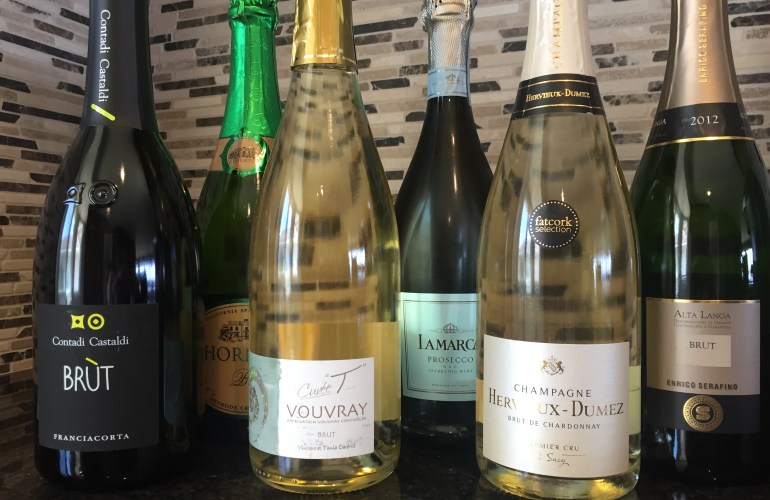
While Prosecco is Italy’s best-known sparkling wine (and best-selling at over 220 million bottles a year!), the country also produces a handful of sparklers made in the same method as Champagne.  And, typically, at a fraction of the cost.  Here are three traditional method Italian sparkling wines that are great alternatives (NOT substitutes, because in my opinion – there is none!) for Champagne:

Franciacorta DOCG.  This region released its first traditional method sparkling wine relatively recently – 1961.  Since then, Franciacorta has enjoyed immense success with their wines and is currently producing over 17 million bottles annually (with the bulk of this being consumed by locals – only around 20% is exported).  In 1995, Franciacorta became the first DOCG in Italy exclusively for traditional method sparkling wine.

Franciacorta is located in Lombardia and has a significantly warmer climate than Champagne.  This translates to riper fruit flavors in the glass and a lower overall acidity.  (Tip: look for “brut nature” or “zero dosage” versions of Franciacorta if you want to maximize acidity).  Interestingly though (to me anyways!), non-vintage Franciacorta is required to spend a minimum of 18 months on the lees – which is 3 months longer than Champagne’s minimum requirement!

The grapes used in Franciacorta are Chardonnay, Pinot Nero (aka Pinot Noir), and Pinot Bianco.  The latter is being used less frequently as it doesn’t add much longevity or energy to the wine.

For more info – here’s my outline on Franciacorta.

Trento DOC.  These wines hail from the Trentino region located in northeastern Italy.  Sparkling wine production started here in the early 1900s here thanks to Giulio Ferrari who believed the area had the potential to compete with the wines from Champagne.  And while these wines are produced in the same method and use the same grapes as Champagne (the holy trifecta of Chardonnay, Pinot Noir and Pinot Meunier) they taste incredibly different.  You’re likely to get aromas of peach, apricot, candied lemon and orange peel from Trento sparkling wines – with maybe a hint of biscuit character if they’ve been aged longer than 3 years. They tend to be fuller bodied with a level of richness to them.

Compared to Prosecco and Franciacorta, Trento DOC has a rather small production – 8.5 million bottles in 2010 (of which the Ferrari house produced nearly 60%) and the bulk of it is consumed locally.  Which might help explain why I haven’t been able to get my hands on one of these . . . yet. 😉

Alta LangaAlta Langa DOCG.  This area is becoming increasingly important for traditional method sparkling wines produced in southern Piemonte.  Although it is a large appellation overall, the actual area under vine is just over 250 acres (roughly 1/3 the size of Central Park).  And Alta Langa production is quite small – just over 600,000 bottles per year. Both planted acreage and production are expected to increase, however, as popularity of this region’s wines has soared in recent years.  And with good reason – they have some pretty strict requirements as far as what goes into the bottle and, as a result, are producing some delicious bubbles! 

Alta Langa vintageAlta Langa DOCG wines are made from a minimum 90% of Chardonnay and/or Pinot Noir.  And, unlike Champagne and the other regions mentioned above, there is no “non-vintage” production here.  All Alta Langa wines must be vintage dated and spend a minimum of 30 months on their lees.  So you’ll definitely find more of those yummy bready aromatics in wines from this region. 

I hope next time you’re thinking bubbles you’ll give one of these a try.  If you do, please let me know what you think! 🙂   Want to learn more about wine and bubbles?    Click the link to the right and subscribe to this blog!!!   


WSET Diploma Unit 2: The Results Are In!

Well, I have officially cleared my first hurdle in my WSET Diploma pursuit!  Now there’s just four more exams and a research paper.   :-/  As I mentioned in my previous post on the Diploma, Unit 2 is required to be taken before any of the other five Units are attempted.  But, once you pass Unit 2, you’re free to move onto whichever Unit(s) you choose.  (Editorial Note by Hubs:  Ms. Noelle passed “with Distinction” – a designation akin to summa cum laude for this particular Unit – the highest honor awarded.  The dogs and I simply couldn’t be more proud of her!!)

As I look back at my studies for Unit 2, there are definitely some habits that I will continue as I move forward with my Diploma pursuit (the “dos”) – and others that I absolutely will not (the “don’ts”).  Now, anyone who grew up reading Glamour back in the day probably recalls their fabulous back page of DOs and DON’Ts.  Although it wasn’t particularly PC – it was absolutely my favorite part of the magazine (admit it, yours too!).  So, without further ado (and with a similar lack of PC) here are my WSET Diploma Unit 2 DOs and DON’Ts:

Glamour2


Unit 2 DOs

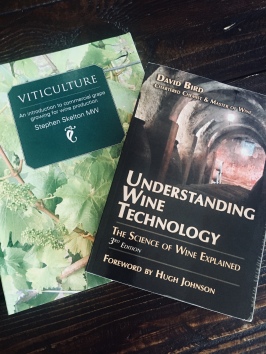
DO read the suggested readings.  Even though all questions on the exam come from the actual Unit 2 textbook, I found the supplemental readings invaluable.  Specifically, Viticulture by Stephen Skelton MW and Understanding Wine Technology by David Bird MW (future book review/blog post forthcoming!)  BooksBoth of these books cover similar information as the Unit 2 text, but they go into more depth and detail.  Being able to read about concepts such as the effects of nutrient deficiencies in a vineyard, or SO2 limitations in wine, in plain English helped me get a more fundamental understanding of the subject matter.  As I might’ve mentioned before – I don’t “science” very well.   😉

DO study every day – even if it’s just a little bit.  Some days I dove into the text for a few hours, and others I just reviewed my outlines and flashcards.  But I honestly don’t think there was a single day in between when I had my first Unit 2 class and when I took my exam that I didn’t study for at least a short while.  I wanted to keep what I learned at the forefront of my brain so it was easy to recall, because believe me, at 45 I have amassed a lot of useless crap in there. (If anyone wants to know the lyrics to any song on The Smiths “Louder Than Bombs” album, or the chronological order of deaths on The Walking Dead, I’m your gal).

Studying
Studying in between flights at SeaTac’s Vino Volo!

DO practice the sample questions in the Unit 2 textbook.  I won’t go into too much detail as to specific questions on the exam, but let’s just say that some of them were eerily similar to the sample questions in the textbook.  Review these.  You won’t regret it.

Unit 2 DON’Ts

DON’T get stuck in the minutiae.  When studying, I have a habit of trying to learn – and memorize – everything.  I tend to get bogged down in the details . . . sometimes at the expense of moving forward.

With Unit 2, I spent a lot of time memorizing types of vineyard pests and learning which rootstocks do best in which types of soil.  And no, this wasn’t because I was fascinated with grapevine yellows or Vitis rupestris.  I was just totally struggling with these areas and thought that if I memorized as much as I possibly could about them that I’d do better on the exam.  So, I spent an exorbitant amount of time on these topics and, while there were a couple exam questions on them, there were more questions on quality control and herbicides – areas that I hadn’t spend much time on because I’d been so in the weeds (pun intended) with others.

DON’T overthink the exam questions.  This advice came to me courtesy of Spitbucket.net after her experience with the exam, and it was spot-on.  Come exam time, you’ve learned so much that you’re likely to overanalyze the test questions and wonder if the examiners are actually asking you something else or trying to trick you.  (Answers: they’re not, and they’re not.)  The Brits might be strict and reserved, but they’re a fair lot.  Feel free to remind me of this quote when I don’t do well on one of my upcoming exams.

And finally, DON’T overdo it. Although I mention above that studying every day is a DO, it is possible to go overboard. Like accessories, sometimes less is more. So if you’re practicing flashcards while getting a bikini wax – you’ve probably taken this too far. Purely hypothetically, of course. :-/

My next WSET class is in a few weeks – I’m tackling Unit 5: Sparkling Wines of the World.  And yes, I’m already making my way through the recommended reading.  But, lesson learned, I’m leaving the book at home before my next appointment at OC Wax.