
Just Beginning to Learn About Wine? Start HERE: Cristie Norman Online Wine Course

If you’re a wine lover on Instagram, you’re likely familiar with the name Cristie Norman.  And if you’re not – you should be.  She’s a Certified Sommelier (currently working at the famed Spago in Beverly Hills), a WSET Level 3 holder, and creator of the wine series “Adulting with Alcohol” on YouTube.  And last year, she debuted a wine apparel line with fabulous taglines like “Vote for Pedro Ximénez” or “Run DRC.”

Cristie Norman

Recently, Cristie added to her list of accomplishments with the launch of the Online Wine Course.  She asked various members of the wine community to take the course and give her an honest review and feedback.  You can read my review here.  However, I was so impressed by the course, I decided to dedicate a blog post to reviewing it in a bit more detail . . .

The Online Wine Course is designed for wine newbies – Cristie refers to it as “a Driver’s Ed Course in Wine.”  It covers a wide range of wine topics in a fun and easy to understand way.  The course consists of over 60 short videos – the majority of which are under 2 minutes, which is perfect in keeping with today’s Twitter and Instagram attention spans. You can go at your own pace, doing one video or several at a time.  Another plus: these videos flow into each other – so you can binge watch with minimal effort!

There are handouts corresponding to each video that you can download and/or print out to follow along. And if you know me, you know how much I love handouts. 🙂 You’re much more likely to remember something if you write it down! For anyone doing the course, I highly recommend printing these out and completing them alongside the videos.  They’re helpful for completing the quizzes at the end of each section and, if you’re a super wine geek like me, they would be great to keep in a notebook for future reference.

Yes, there are quizzes.  They’re timed (10 minutes) and either multiple choice or True/False.  But don’t stress – you can take them as many times as you’d like if you miss any questions.  And I might have had to do that . . .

While her website provides an overview as to what’s included in the course – here’s a little more detail – and in outline form of course!

I.  Intro to Wine

II.  How to Taste Wine

A.  Structure – Acidity, Tannin & Sugar

B.  Aromas/Flavors

III.  Sparkling Wine

A.  Methods of Production & Styles

B.  Styles (Champagne, Prosecco, Cava, Crémant)

C.  How to Open a Bottle of Sparkling Wine.  (Hint: it doesn’t look anything like these). Willamette

IV.  Important White Grapes & Red Grapes.  Thankfully she includes the correct pronunciation of the Willamette Valley here.  Never ceases to amaze me how many people say it incorrectly.

V.  Why is Wine so Expensive?

A.  Use of Oak.  Cristie includes mention of oak chips here – which (impressively) she doesn’t shame.  She just sticks to the facts like “yep, some bulk producers use them” and doesn’t give her personal opinion.  And believe me, we wine folk have TONS of opinions!

B.  Winemaking Decisions

C.  Marketing.  She does briefly mention influencers here – as she should – she is one!

VI.  How to Open and Serve Wine.

A.  This includes a detailed demonstration – which, of course, she makes look so damn easy.  Even after watching this several times AND being shown in person by a Master Sommelier – I still cannot get the knife right!
Gramercy

B.  Like many things these days, there is some product placement during this section. However, unlike Game of Thrones and Starbucks, both products Cristie mentions make sense. And as someone who Hubs often refers to as “Jane Q Public” – I found myself interested in both. (Albeit a bit skeptical that one claims to keep a wine fresh after being opened for weeks or months . . . )

VII.  Terroir

A.  One of the most controversial words in the wine world (this and influencer).  Cristie gives the big picture of how soils, climate, etc. all factor into a wine.  She also does a particularly excellent job of describing the differences between Old World and New World here.

B.  Note: I see this word misspelled constantly.  Usually the vowels are mixed up and it looks like Terrior.  Here’s how I remember it: “how do you spell Terroir?”  “oh, I don’t know” Get it?  O I.  You’re welcome.  (Hubs Note:  Nerd.)

VIII.  France

A. Great introductory explanation of more complicated topics like the 1855 Classification, Napoleonic Code and Burgundy pyramid.  Something even more advanced wine aficionados struggle with!

B. The quiz questions definitely start to get tougher here – I highly recommend using her worksheets!

IX.  Italy

A.  Somewhat ironically, this was the only section where this Italian Wine Scholar got a question incorrect. :-/

B. As someone who has studied this region in depth, I truly admire her ability to cut through the minutiae and get right to the important facts.  Not easy to do for a country with over 350 native grapes! WA necklace

X.  The United States (with a brief discussion of my beloved Washington state!)

XI.  Spain & Portugal (including mentions of Sherry & Port)

XII.  South America

XIII.  Germany (she admirably tackles the complicated topic of sweetness levels in German wines – something I STILL need to reconfirm on occasion!)

XIV.  Other Southern Hemisphere Countries: Australia, New Zealand and South Africa

XV.  Food & Wine Pairing. I’ve taken several classes on this topic, yet Cristie manages to explain concepts in a unique way that I’ve never seen before.

To the best of my knowledge, there is nothing else out there like the Online Wine Course. Sure, there are plenty of books – Wine Folly and The Wine Bible are two of my top recommendations for people who are newer to wine. There are also classes like the WSET Level 1 or the Introductory Sommelier Course if you’d prefer to go the certification route. However, there’s a certain degree of formality with these types of classes and you’re at the mercy of their schedule. There’s little, if any, flexibility – and unfortunately, attending in your PJs is frowned upon.

On her site, Cristie mentions that “reaching millennials is the key.” And unless you’ve been avoiding all forms of social media, you’re probably well aware of the wine industry’s efforts (or lack thereof) of doing just that. However, I can see someone of an, ahem, “older generation” (present company included!) enjoying this course just as much. The Online Wine Course would be a great gift for someone just starting out in wine – whatever their age.

 

Italian Wine Scholar: Tackling This Boot Was No Small Feat

Nobody likes a braggart or a know-it-all.  If you’ve read some of my previous posts, you know I can’t stand this type of personality and have even created a WSET Irritation Scale to evaluate them.  (Yes, I’ve been told that sometimes I take things too far).

Unfortunately, we (mostly women) are often so fearful of looking too egotistical that we don’t celebrate our accomplishments.  We downplay our successes, or qualify them by saying something like “I’m just a good test taker” or “I can memorize facts, but don’t retain them very well.” (I’ve uttered both of these phrases many times over).  Why is it so difficult to say “hey – I’m really proud of myself, I did this: [fill in the blank here with your awesome accomplishment].”  (Hubs Note:  And yet you don’t have any problem telling my friends that you kicked my ass in law school).

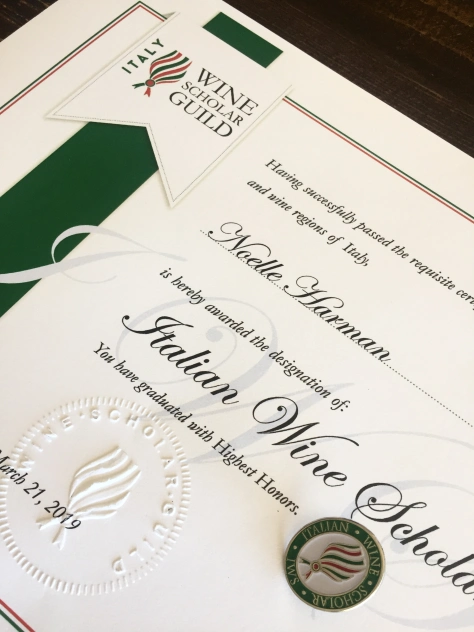
I think we need to be better at sharing our wins and encouraging each other to do the same. So, with that, I’m going to give it a shot- here goes: I passed my Italian Wine Scholar exam with Highest Honors!  I studied my ass off for this certification and I am thrilled with my results.

IWS certificate

And, because I’d like to see others succeed, here are some tips that will hopefully help other students rock their Italian Wine Scholar Unit 2 exam (my Unit 1 exam tips can be found here):

1. Study the glossary!

There were several questions relating to these terms and I know I answered at least one of them incorrectly.  Now I will never forget that Baglio is the name for a Sicilian farmhouse.  (However, the degree to which this particular question relates to wine knowledge is debatable IMO . . .)

2. Memorize this equation: The percentage of the text dedicated to a region = the number of exam questions on that region.

This may seem obvious, but it will help you schedule your time more efficiently if you keep this in mind.  You’re better off focusing a majority of your studies on Toscana, Sicilia and Campania than knowing all the little nuances of Molise or Basilicata.  And besides – you can use my outlines as a good starting point for both of those regions! 😉

For me, I found it best to tackle a larger region over the course of a week and then follow this up with a day covering a smaller one.  Being able to knock out a more minor region in such a short period gave me a much needed sense of accomplishment when I felt I was dragging.  Which happened more than I’d hoped!

3.  Read the answers carefully!

I know most people say read the question carefully, and clearly you should do that too, but Calabria and Campania were both options for a few questions.   Maybe it’s just me, but throughout my Italian Wine Scholar studies I would get these two regions mixed up.  Make sure you know which one you’re talking about!

4. If you don’t know the answer, move on and come back to it.

You very well may find a clue to the answer in a later question or something might trigger your memory.  This happened to me with an exam question on Verdicchio – I skipped it and a question later in the exam helped me recall the answer.  And don’t stress out too much if you have to temporarily skip a question – having an open and relaxed mind will make it easier for you to recall the information you need. (If that sounds like Headspace to you – it is!  I always do a short meditation the day of an exam . . . consider that another study tip.)   (Hubs note:  With the dogs.   She meditates with the dogs.  I don’t even know how this is possible).

5.  Don’t underestimate Sardegna.

I left Sardegna until last and, frankly, didn’t spend much study time on this region.  I figured that since it was an island, and not even the most “important” one, that there wouldn’t be many exam questions related to it.  However, I should have heeded my own advice above regarding “size of the chapter = exam importance” because based on this theory – about 8% of the exam questions would be related to Sardegna.  And although I didn’t count, there probably did end up being somewhere between 7-9 questions on it.  Thankfully, I read and reviewed Sardegna the morning of the exam so I was able to at least recall specifics relating to the island’s grape varieties.

And finally, this is not really a “tip” but something to keep in mind throughout your studies: enjoy learning.  After over a year of being in the Italian Wine Scholar program, I am so thankful to have a better understanding of, and appreciation for, Italy.  You don’t need a certificate or a pin to prove anything.  But if you have one – be proud of it.  I am!


Wine Education Classes: In Person vs. Self-Study

Last year, I took the first of two exams to obtain the Italian Wine Scholar (IWS) certification through the Wine Scholar Guild.  I’m scheduled to take the second exam in less than one week.  Before enrolling in the IWS program, Italy was my Achilles heel of the wine world.  But now that I’m nearing the end of the course, I can assuredly say that I have much better understanding of (and perhaps more importantly, appreciation for) Italian wines.

The Wine Scholar Guild gives students a couple of options for pursuing their Italian (or French, and soon to be Spain) Wine Scholar certifications.  The first is through independent study and the other is by attending a series of classes in person.  I did the first half (Northern Italy) through self-study.  For the Central/Southern portion of the certification, I attended a weekend intensive course last month with The Wine and Spirit Archive in Portland, Oregon.

So I’ve experienced the best (and worst) of both options.  And while I should be reviewing for my exam right now, instead I’m thinking about which route I preferred and would recommend to others pursuing one of these certifications – or really, any wine certification for that matter.  Some people (Hubs) might call this procrastinating . . .

Honestly, there’s no one size fits all for wine education.  It all depends on what you want to get out of the course – and how you, personally, study best.

Self- Study: Pros and Cons

The primary reason I opted for self-study for my first exam was, well, there were no classes offered anywhere near where we lived.  So, needless to say, that was a pretty easy decision to make.  Shortly after registering, I received the Northern Italy coursebook and access to the Wine Scholar Guild online materials – which includes webinars, quizzes and flashcards.  After that, I was on my own.

Besides being able to attend class in your jammies, here are some benefits to self-study:

You’re in charge!  With self-study, you get to move at your own pace, set your own schedule, and study sections in the order you choose.  As such, this option might appeal more to those of us who can be (ahem) Type A personalities.  For example, I jumped around instead of following the book chronologically.  I wanted to get an “easy” region out of the way first so I could find my groove, so I started with Liguria.   It’s a smaller region with only a handful of DOCs – plus I’ve actually visited Liguria, so I wasn’t starting with a completely blank slate.  Additionally, self-study allowed me to accommodate my rather wacky schedule last year – which included moving a thousand miles away from my beloved Washington state and starting my WSET Diploma studies.

Fewer distractions outside your control. In class, there are other students asking questions, requesting the instructor repeat something for the umpteenth time, telling personal stories, spilling wine, etc.  With self study, your focus is on you – nobody else.

However, my home situation is probably a lot different than most people’s.  Hubs is at work and I have a couple of old dogs who sleep all day.  That isn’t to say that both pups haven’t been wonderful study buddies. 🙂  But if you have a larger family, young kids, roommates, live in a noisy apartment, or have a husband who incessantly watches ‘It’s Always Sunny in Philadelphia’ at full volume – then an in-class experience might have fewer distractions for you.  (Hubs Note:  It’s one of the most intelligent shows on TV these days).


And now the downside of self-study . . .

Accountability and self motivation are necessities.  If you don’t have both of these, you probably won’t succeed with self-study.  I highly recommend creating a study schedule at the beginning of your course and sticking to it.  This should be realistic roadmap of what you need to accomplish before the test date and take into account anything you already have scheduled that might detract (or distract) from studying: travel, work, family commitments, etc.  You should plan to dedicate yourself to tackling a little bit (almost) every day – this exam is not something you can cram for.

Lack of Support System.  With self-study, you’re on an island.  You have your manual and online materials – but what if you have questions?  Or just want to check with someone to make sure you’re on the right track?  Or you want vent about how mind numbing it is that there are so many DOCs and sub-zones in Tuscany that sound the same: Montecarlo, Montecucco, Montalcino, Montalbano, Montespertoli – seriously?!

The Wine Scholar Guild has an online Instructor Q&A Forum – and from what I can tell, there is a pretty quick turnaround for responses.  However, it also appears that this isn’t used very frequently (the last post was almost four months ago).  With the in-class study route, you still have access to this Q&A Forum – plus your instructors from class as well as other students.  And sometimes, just knowing there’s a wider safety net is comforting – even if you don’t need it.

In-Class Experience: Pros and Cons

As I mentioned, I flew to Portland a few weeks ago to attend a weekend long intensive course for the second half of the IWS certification which focuses on Central and Southern Italy.  I was planning to continue with self-study, but after seeing that an in-class option was available and taught by two of my very favorite wine instructors – I knew I wanted to do this second part with them.

Mimi Martin was my WSET Level 3 instructor in 2017.  For Level 3, being able to connect the dots between many different concepts is imperative to passing the exam.  This wasn’t a memorize and regurgitate kind of thing – you needed to thoroughly understand the material and be able to explain your reasoning behind an answer.  In classes, Mimi broke down all the required text into manageable sized sections that made it easier to understand the details – as well as to see the big picture.  After passing Level 3 (with Distinction!) I started looking at wine in a whole new way – thanks in large part to Mimi.

I’d taken a couple classes with Tanya Morningstar Darling at Northwest Wine Academy when I lived in Washington.  She has such a unique way of approaching wine education – seriously, she sometimes makes me feel like I’m combining my wine studies with meditation.  Her teaching style eliminates much of the franticness of memorizing and cramming and leaves me with a true enjoyment of learning.  (Did that sound as Zen as I think it did?)  She recently started her own wine events and education business fittingly named Cellar Muse and if I’m ever back visiting while she has one of her classes in session, you can bet I’ll be there.

So, besides (hopefully!) having awesome instructors like I did, here are some other benefits to attending class in person:

Connecting with other students.  When you’re part of a class, there’s often a sense of “we’re all in this together!” type of thing.  You realize you’re not the only one frustrated or overwhelmed.  My recent IWS class happened to be one of the most enjoyable classes I’ve ever been in.  I got to know some wonderful people that I’d only “met” previously through social media and I also reconnected with a gal from my hometown that I’d known back in junior high.  She’s now a winemaker – what a small world.  I have no doubt that I’ll stay in touch with many of these future Italian Wine Scholars.

On the flipside, let’s be honest: you’re not always going to get a “dream class” of awesome students.  There are plenty of irritating or know-it-all wine students and it’s quite likely one or more may be in your class.  The degree to which they bother you depends on your tolerance level (undoubtedly higher than mine) and their specific behavior which, in my experience and to put in WSET terms, can range from:

  • Medium Minus: Mildly annoying – they chime in with every…single…little…aroma that they smell; to
  • Medium Plus: Rather obnoxious – they correct the instructor when she’s off by one kilometer on the distance between two villages in Burgundy; to
  • High: Infuriating, they claim to have passed the WSET Level 3 with Distinction without studying and condescendingly call the whole process “ridiculously easy.”  (Yes, I’ve mentioned him before . . . clearly he grinds my gears.  Thankfully, I’ve only “met” this type of student online).

Wine Tasting!  This is a HUGE plus with the in-class route.  You get to taste, evaluate and discuss a number of wines during class – which not only gives you a better overall sense of the region you’re currently studying, but also helps you continue to improve your tasting skills.  During my weekend intensive class, we tasted almost 50 different wines over 3 days!  Many of which I wouldn’t have been able to find in my area had I opted for self-study.

And now for the cons . . .

Intensity of Focus. These days, most of us aren’t used to sitting and focusing for hours at a time on our particular course of study.  Going the classroom route requires lots of both – particularly if you enroll in a weekend intensive class like I did.  My attention drifted off as the day went on as I started researching which food truck I was going to grab dinner at after class and how late Powell’s City of Books was open (FTR – 11pm).

My tasting notes also dropped in detail over the course of the day – from elaborate, several paragraph long descriptors of structure and aromas  to “deep ruby, cherry and balsamic” near the end of the day.  Plus my back hurt like hell.  If you’re under 35 – you won’t understand.  But someday you will.  Just trust me – it sucks.

Tangents and Rabbit Holes.  While in-class discussion can be interesting, it can sometimes be time consuming. For example, after reviewing the various biotypes of Sangiovese, my class got on the subject of clones.  Which, although educational, wasn’t particularly relevant to the class at hand.  And, after this discussion went down the proverbial rabbit hole, we ended up running out of time to thoroughly cover a few regions.

This invariably happens in every class, but is nonetheless frustrating if you’re not participating in the tangential discussion.  So, if you’re the one continuing to burrow down the rabbit hole – take into account your fellow students and whether they’d truly like to be joining you there, or whether it would be best if you followed up with the instructor on your own time.  Otherwise, you might end up on my WSET Irritation Scale above. 😉

And whether you’re opting for self-study or in-class, I’m hoping you’ll find these outlines on Marche and Basilicata helpful to your studies!  Best of Luck!!